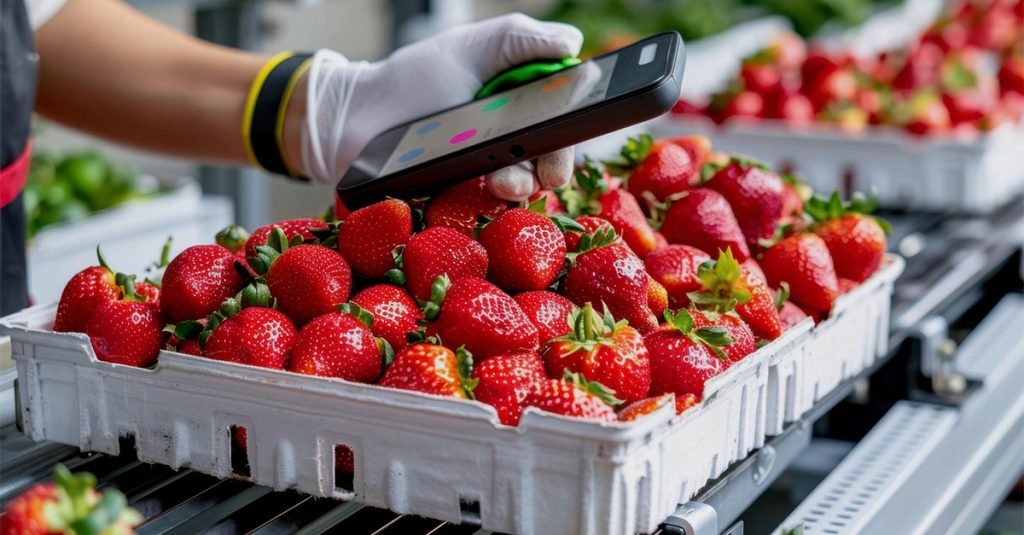
Here’s a strawberry fact that should bother you: by the time those East Coast store berries hit the shelf, they’re already 4-7 days past harvest.
And that’s before a single customer picks up the carton.
So when people talk about “fresh produce,” there’s a gap between what that word promises and what the calendar says.
A big one.
Roughly 30-40% of the U.S. food supply gets lost or wasted annually. That’s nearly 60 million tons per year, valued at around $218 billion, and produce leads the pack. Meanwhile, 22% of what fills municipal landfills is food that never reached anyone’s plate.
Most people blame the “sell by” date. Naturally. But the truth is, the real shelf life clock starts ticking way before that: at the dock appointment, during dwell time, inside the route plan. Every wasted hour between harvest and delivery is an hour your product can’t get back.
We built NT Logistics around that reality. One of the reasons our four pillars (Single Source, Outrun the Bear™, NTelligence™, People Power) and Routing-as-a-Service Plus (RaaS+) exist in the first place is to make shipping produce a system that respects the clock, not a daily scramble that ignores it.
Fresh produce doesn’t usually fail because of bad farming. It fails because of what happens between the farm and the shelf. Missed appointments, long dwell times, and sloppy routing each steal freshness hours that no one notices until the product looks tired under store lights. And for most perishables, the margin for operational waste is practically zero.
The bleed starts here. A missed dock window rarely means a short delay. It usually means a next-day delivery, and that burns a serious chunk of whatever shelf life remains on high-velocity items like berries or leafy greens. Every reschedule is a withdrawal from your product’s freshness account, and you can’t deposit time back.
The financial side compounds quickly too. Chargebacks tied to appointment and routing-guide compliance commonly run 1-5% of invoice value, and retailers treat missed windows the same way they treat temperature excursions: as service failures that trigger penalties. Appointment discipline protects freshness. It’s not paperwork.
Even when the appointment lands on time, you’re still in a race against time if the trailer sits at the dock too long. Temperatures drift, handling churn increases, and your product ages while nothing productive happens. That’s shelf life evaporating in a parking lot.
Excessive dwell also creates a domino effect. The longer a trailer sits at one stop, the tighter the windows get for every stop after it. Downstream deliveries get compressed or missed entirely, and each one of those delays shaves more hours off the product that was fresh just that morning.
All that lost time from missed appointments and excessive dwell forces drivers into suboptimal routes. Extra miles mean extra door openings, extra handling, and extra exposure to conditions your product can’t afford. For example, romaine lettuce holds about 21 days of shelf life at 0°C but drops to roughly 14 days at 5°C. Routing decisions that add time in warmer conditions spend shelf life you’ll never get back.
“Fastest” and “freshest” aren’t always the same route. Sequence, constraints, and daily variability all matter, and static routing ignores all three.
QA can validate product conditions at handoff. But logistics determines how much sellable life remains when the customer picks it up. The operational leaks above aren’t quality problems. They’re logistics problems with quality consequences. Here’s why that distinction matters.
Every perishable product ships with a finite freshness budget. Cooling delays burn through it fast. UC Davis research shows that delays beyond one hour measurably reduce the percentage of marketable fruit. Temperature discipline changes the math just as dramatically: romaine lettuce holds around 21 days at 0°C but drops to 14 at 5°C. Your logistics operation controls both of those variables. QA doesn’t.
Whatever shelf life logistics burn, retailers feel it at the display case. USDA analysis shows an average 11.6% supermarket loss rate across 31 fresh vegetables, with billions of pounds lost annually. Zoom out further and produce leads all food waste categories at 32 million tons per year, valued at nearly $70 billion. The retail buffer everyone assumes exists? It barely does. So every hour logistics waste hits the bottom line twice: once as shrink, once as lost revenue.
Missed appointments and cold-chain exceptions trigger chargebacks, which create rework, which causes more delay, which costs more freshness. It feeds on itself. Detention-driven volatility also increases safety risk and reduces schedule reliability, which amplifies late deliveries down the line. One service failure rarely stays one failure for long.
Missed appointments, dwell, and bad routing drain your shelf life. And as we covered, freshness isn’t a QA problem with logistics side effects. It’s a logistics responsibility with QA consequences. So the fix can’t come from better inspections or tighter spec sheets. It has to come from how your operation runs every single day.
That’s precisely what we solve at NT Logistics.
Nobody standing in a grocery aisle thinks about dock appointments, dwell time, or route sequencing. They pick up the product, judge it in about two seconds, and either put it in the cart or put it back. That split-second decision is the end of a chain that started days earlier at your dock. And every operational hour you lost along the way just voted against you.
That’s what makes shipping produce so unforgiving. Your farm can do everything right. Your QA team can run a tight program. But if your logistics operation leaks hours between the dock and the shelf, the customer sees a tired product and moves on. They don’t care whose fault it was. We built NT Logistics for the shippers who got tired of watching that happen and wanted a partner obsessed with the same clock they are.
Want to see where your sellable days are going? Contact NT Logistics or request a free assessment. Let’s build a practical plan together.

7460 Warren Parkway, Suite 301
Frisco, TX 75034
Toll-free: 800.801.5970
Dallas Area: 469.362.5000


Subscribe to our newsletter