
Five stops can run in 120 orders. One is 18.5% shorter.
A worked example close to home: one truck leaves Frisco, makes five deliveries around Dallas and comes back. We kept the same stops and changed only the order.
- Origin
- Frisco, Texas
- Stops
- Five
- Possible orders
- 120
- Saved
- 19.8 miles, 18.5%
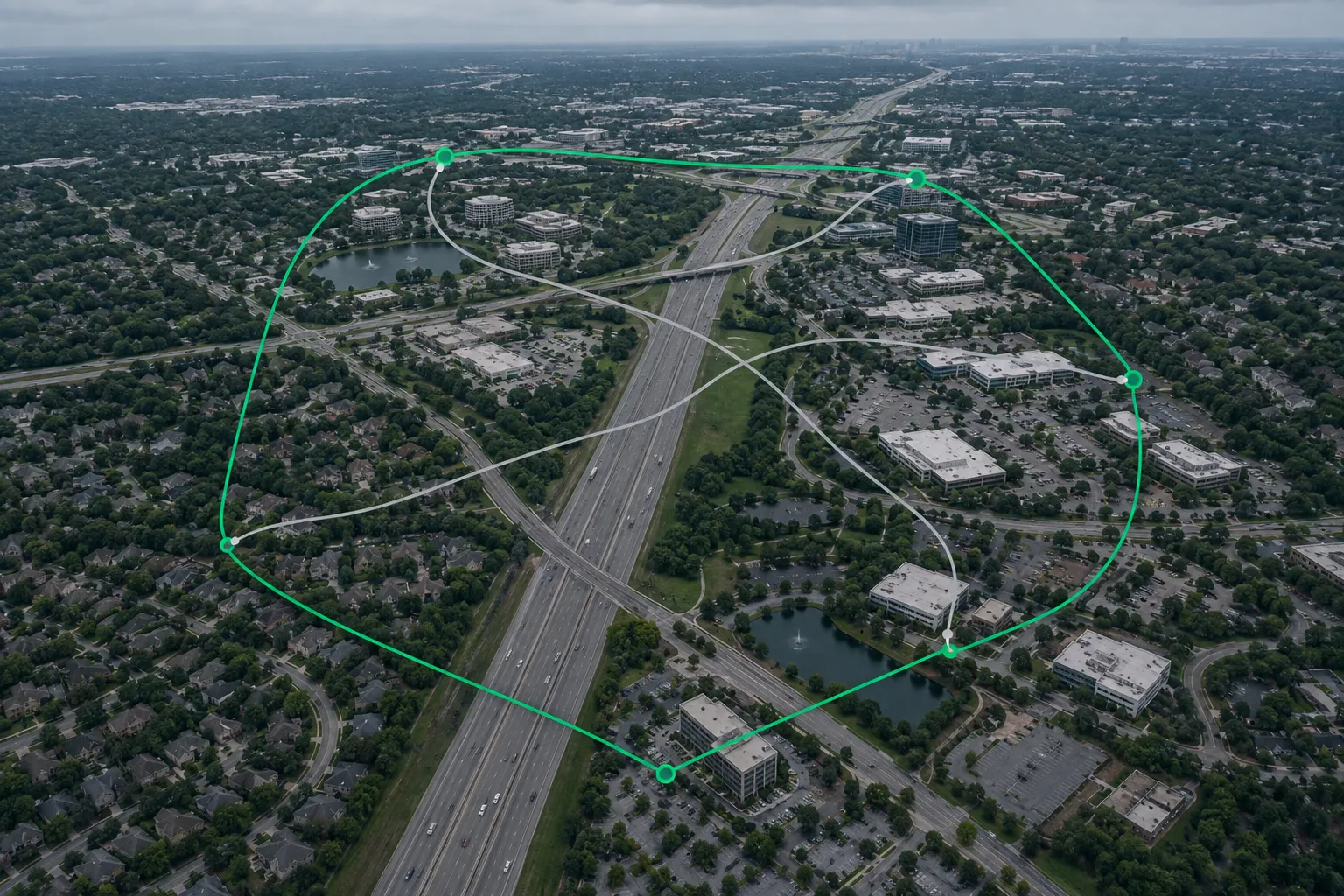
The order as listed
| Leg | To | Miles |
|---|---|---|
| 1 | Teel Pkwy, Frisco | 4.8 |
| 2 | Hedgcoxe Rd, Plano | 10.2 |
| 3 | Belle Grove Dr, Richardson | 14.0 |
| 4 | Airport Pkwy, Addison | 10.0 |
| 5 | S Goliad St, Rockwall | 31.3 |
| Return | Stonebrook Pkwy, Frisco | 36.6 |
| Total | 106.9 |
The same five stops, reordered
| Leg | To | Miles |
|---|---|---|
| 1 | Hedgcoxe Rd, Plano | 6.0 |
| 2 | Belle Grove Dr, Richardson | 14.0 |
| 3 | S Goliad St, Rockwall | 20.4 |
| 4 | Airport Pkwy, Addison | 26.3 |
| 5 | Teel Pkwy, Frisco | 15.5 |
| Return | Stonebrook Pkwy, Frisco | 4.9 |
| Total | 87.1 |
That’s 19.8 fewer miles for one truck on one day. Across a fleet over a year, those miles show up in fuel, maintenance and driver hours.
Why nobody does this by hand
Five stops can be run in 120 different orders. Ten stops can be run 3.6 million ways. A fifteen-stop route, which is an ordinary day for a lot of delivery fleets, has more than a trillion. Average speed, dwell time at each dock, traffic patterns and the size of the service area all change which one is best. That’s a job for routing software, with someone who knows the roads checking that the answer can actually be driven.
What each stop is worth
Put a $100 sale on each stop and price the time and miles to reach it, and one of the five stops costs more than it earns.
| Stop | Sale | Cost to serve | Margin |
|---|---|---|---|
| Plano | $100 | $34.68 | $65.32 |
| Richardson | $100 | $28.97 | $71.03 |
| Rockwall | $100 | $201.12 | −$101.12 |
| Addison | $100 | $55.22 | $44.78 |
| Frisco | $100 | $28.41 | $71.59 |
Once you know that number, you can talk about a minimum order or a delivery charge for Rockwall.
The full paper this example comes from: Navigating Excellence →